


RCC Pipe Load Calculation: Explained for Engineers & Contractors
RCC pipe load calculation is one of the most critical steps in designing safe and durable drainage or sewer systems. Without proper load analysis, pipes may crack, deform, or fail under pressure. Therefore, engineers must understand how different loads act on RCC pipes before installation.
In this guide, we will explain RCC pipe load calculation in a simple yet technical way. Additionally, we will cover formulas, real-world examples, and practical tips for contractors.
What is RCC Pipe Load?
RCC pipes are subjected to different types of loads once installed underground. These loads mainly come from soil, traffic, and environmental conditions.


Types of Loads Acting on RCC Pipes
Dead Load (Soil Load)
This is the weight of soil above the pipe. It depends on trench depth and soil density.Live Load (Traffic Load)
Vehicles moving above the pipe create dynamic loads.Hydrostatic Load
Groundwater pressure acting on the pipe.Internal Load
Load from water or sewage flowing inside the pipe.
Basic RCC Pipe Load Calculation Formula
To begin with, the most commonly used formula for vertical load (Marston’s theory) is:
W = C_d \times w \times B^2
Where:
W = Load on pipe (kg/m)
C_d = Load coefficient (depends on trench condition)
w = Unit weight of soil (kg/m³)
B = Trench width (m)
Example of RCC Pipe Load Calculation
Let’s understand this with a simple example.
Given:
Trench width (B) = 1.2 m
Soil density (w) = 1800 kg/m³
Load coefficient (C_d) = 1.5
Calculation:
W=1.5×1800×(1.2)2W = 1.5 \times 1800 \times (1.2)^2 W=1.5×1800×1.44=3888 kg/mW = 1.5 \times 1800 \times 1.44 = 3888 \, kg/m
👉 Result: The load acting on the pipe is 3888 kg per meter length.
Supporting Strength of RCC Pipes
After calculating load, it must be compared with pipe strength.


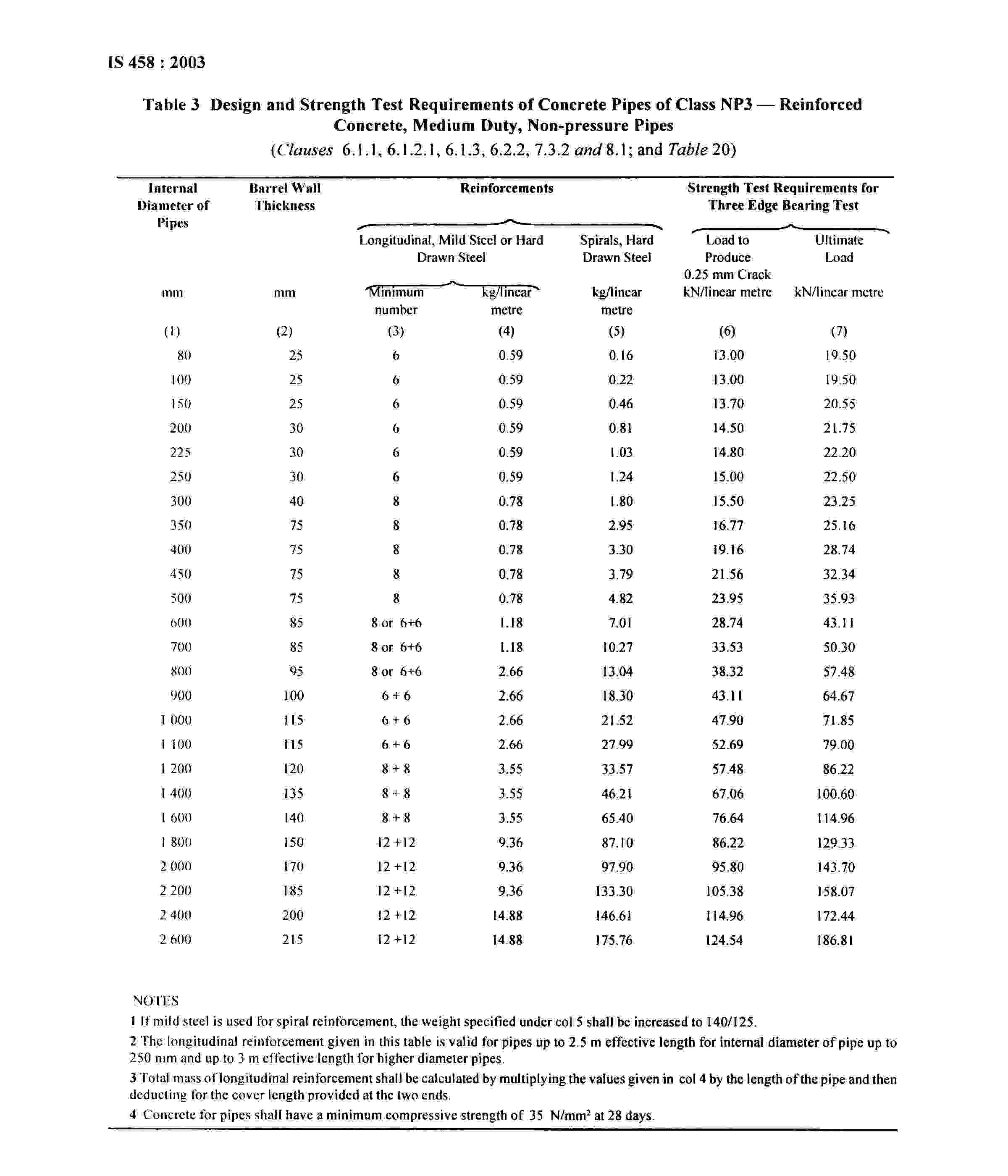
Standard Strength Classes
NP2 Pipes – Light load conditions
NP3 Pipes – Medium load (most common)
NP4 Pipes – Heavy load / highway conditions
👉 Always ensure:
Pipe Strength > Calculated Load
Factors Affecting RCC Pipe Load Calculation
Several real-world factors influence the final load:
Depth of burial – Deeper pipes face higher loads
Soil type – Clay, sand, and rock behave differently
Trench condition – Narrow vs wide trench
Compaction quality – Poor compaction increases risk
Traffic intensity – Highways vs rural roads
Practical Tips for Engineers & Contractors
Always use proper bedding to distribute load evenly
Avoid over-excavation of trench width
Ensure layer-wise compaction of soil
Select correct pipe class (NP2/NP3/NP4) based on load
Follow IS 458 standards for RCC pipes
Common Mistakes to Avoid
Ignoring live load from traffic
Using incorrect soil density values
Not considering groundwater pressure
Choosing lower-grade pipes to reduce cost
👉 These mistakes can lead to pipe failure and costly repairs.
Conclusion
In conclusion, RCC pipe load calculation is essential for ensuring long-term performance and safety. While the formula may seem simple, real-world conditions require careful analysis. Therefore, engineers and contractors must consider all load factors before selecting pipe class and installation method.
FAQs
1. What is the most important factor in RCC pipe load calculation?
The most important factor is soil load, as it contributes the highest pressure on buried pipes.
2. Which RCC pipe class is best for highways?
NP4 pipes are recommended for heavy traffic conditions.
3. Why is trench width important?
Because load increases with the square of trench width (B²), making it a critical parameter.
📧 Mail Us: Sales@balajispunpipe.com
📞 Contact Number: +91 99929 06006
🌐 Visit Our Website: www.balajispunpipe.com
You can also follow us on LinkedIn for updates.